Why Funding Alone Won't Transform Women-Led Businesses
-
 By Daniel Arinola
 - Hernovate
- Jul 29, 2026
- 3 minutes read
- 6 Views

There is a young woman in Lagos, Nigeria who has been sewing straight out of school. She has customers, a machine she owns outright, and a reputation good enough that people go to her. She also cannot tell you, with any confidence, whether her most popular style makes her money or costs her money. She is not unusual. She is the Nigerian informal economy.
Nigeria has roughly 39.7 million micro, small and medium enterprises, and 38.4 million of them are nano- and micro-businesses. Women own about a third. In the trades where Hertisan works, that share climbs sharply: women hold 86.8% of accommodation and food services, 68.7% of manufacturing, 64.5% of wholesale and retail trade. National Bureau of Statistics (2024) says that "The informal sector these businesses sit in accounts for more than half of national economic activity, and 92.2% of all employed Nigerians work within it." .
Then the numbers turn. As of 2023, 30% of adult Nigerian women, nearly 17 million, were excluded from financial services, against 21% of men. Only 5% of adult women accessed credit from a formal financial provider. Across Africa, women entrepreneurs face a financing gap the African Development Bank puts at roughly $42 billion. The sector has read these figures and reached a single conclusion: get women capital.
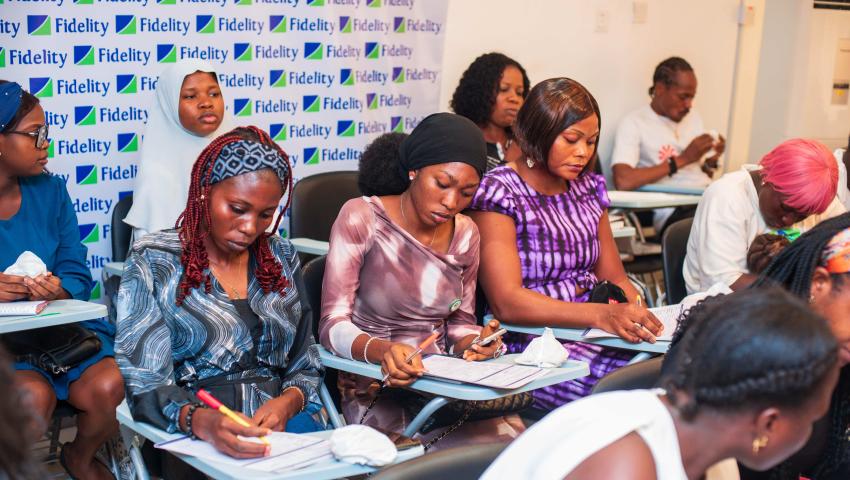
At Emerging Communities, we think that conclusion is half right, and the half that is missing is the half that determines whether the capital works. In our first Hertisan cohort, we met women who could not define a margin or were pricing below cost, or using the price was set by what the woman in the next stall charged. Women did not understand the value of records and were not keeping them, because business money and household money moved through the same pocket. Women who wanted to reinvest could not, because they were not the person who decided how their own earnings were spent.
A woman can score full marks on financial literacy and still be unable to act on a single thing she has learned. So for Hertisan Cohort 2 we rebuilt our system to accommodate the following: Understanding, does she know the basics? Decision-making, can she make good choices with what she knows? Behaviour, what does she actually, repeatedly do? Agency, can she act on her decisions, or is something stopping her? Resilience, how does she recover when something goes wrong? Aspiration, does she believe a different financial future is possible?
A programme that raises knowledge while leaving household decision-making power untouched has produced a well-informed woman with no more control over her money than before. And resilience is not theoretical: Moniepoint's 2025 informal economy report found that 42% of Nigerian informal businesses could survive a month or less without income. One illness, one theft, one slow season undoes three years of growth. Capital deployed into an enterprise with no costing discipline, no records and no shock buffer does not compound, it evaporates, and the woman is left carrying the repayment. Capability is not the soft precursor to finance. It is the thing that determines the return on it.
Hertisan Cohort 2 takes 250 women through that framework this October. By 2035, we intend to reach ten million.
The economic case is not subtle. Nigeria's informal economy carries a significant share of household income, and women hold much of it. A woman who prices correctly does not simply earn more. She hires. She saves. She restocks. She keeps children in school. Multiply that across a market and this stops being a training programme. It becomes repair work on a layer of the economy that has been quietly bleeding for decades.
That is the work. We are at the beginning of it.

Daniel Arinola
Leave a comment
Your email address will not be published. Required fields are marked *